

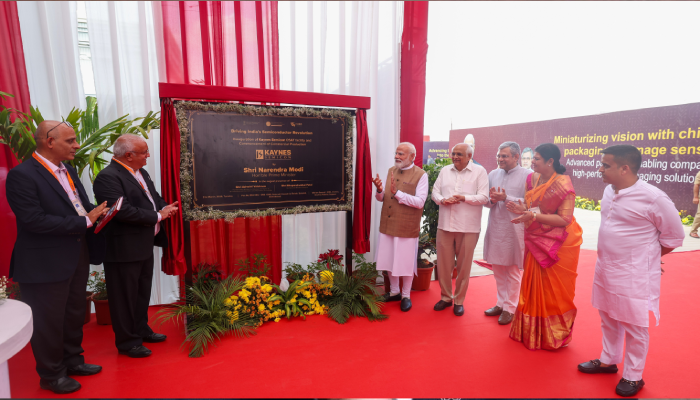
India’s Prime Minister Narendra Modi inaugurated the ₹3,300 crore semiconductor facility by Kaynes Semicon in Ahmedabad, marking a major milestone in India’s push to build a self-reliant semiconductor ecosystem.
The Sanand-based plant, developed under the India Semiconductor Mission, is an outsourced semiconductor assembly and test (OSAT) facility focused on chip packaging and testing. It becomes India’s second operational semiconductor unit after Micron Technology began production earlier this year, highlighting the rapid expansion of the country’s chip manufacturing capabilities.
Commercial production has already started with Intelligent Power Modules (IPMs), which are widely used in electric vehicles, industrial systems, and energy-efficient applications. Once fully scaled, the facility is expected to produce around 6.3 million units per day, with a strong focus on exports, reinforcing India’s “Make in India, Make for the World” vision.
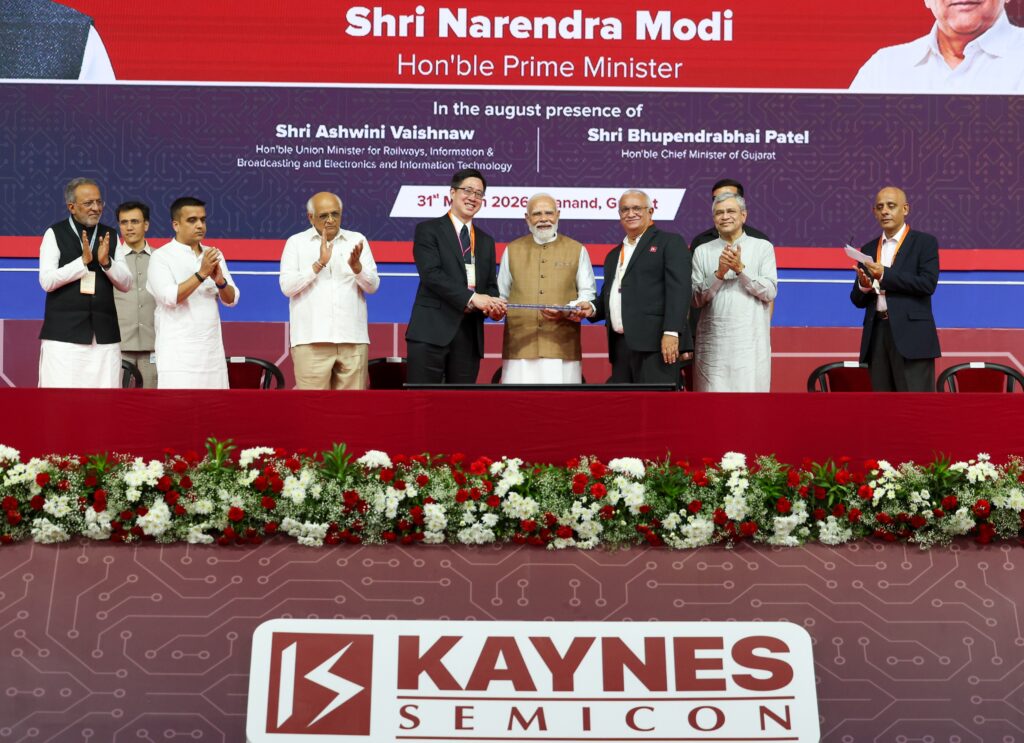
The Prime Minister emphasized that India is emerging as a trusted global semiconductor supplier, with domestic companies like Kaynes becoming key players in the global supply chain. He noted that semiconductors are foundational to sectors such as AI, clean energy, defense, and electronics, and announced plans to advance the ecosystem further under the upcoming “India Semiconductor Mission 2.0“. The government is also focusing on building a full-stack ecosystem, including research, talent development, and supply chain resilience through initiatives like the National Critical Minerals Mission.
Gujarat Chief Minister Bhupendra Patel highlighted the state’s rapid progress in semiconductor development, positioning Sanand–Dholera as a future “Silicon Valley” of India. He also emphasized investments in skill development and infrastructure to support emerging sectors like AI, semiconductors, and renewable energy.
Union IT Minister Ashwini Vaishnaw noted that the Kaynes facility was completed in just 14 months, reflecting the speed of India’s semiconductor push. He added that multiple semiconductor plants are expected to become operational in the coming years, with India aiming to become one of the top global semiconductor hubs by 2032.
With strong government support, increasing global investor interest, and rapid infrastructure development, the Kaynes plant represents a significant step toward reducing import dependency and establishing India as a major force in the global semiconductor and electronics manufacturing ecosystem.
