

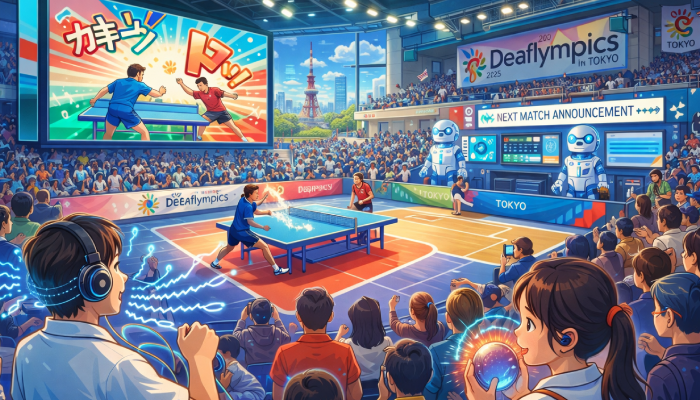
At the Tokyo edition, organisers introduced new assistive technologies aimed at ensuring deaf fans fully experience the energy, drama and atmosphere of live sporting events.
The live sports experience has always been defined by atmosphere — the crack of a bat, the blast of a whistle, the roar of a crowd. But what if you couldn’t hear any of it? At the 2025 Deaflympics in Tokyo, technology redefined how deaf and hard-of-hearing fans experience sport. Through AI-powered tools, visual sound systems, and immersive vibration technologies, the Deaflympics emerged as a global innovation hub for accessible sports technology.
The Deaflympics: A Global Stage for Inclusive Sports Innovation
For more than a century, the Deaflympics has been the pinnacle of elite competition for deaf athletes. Today, it also serves as a real-world testing ground for inclusive design in sports. Engineers, accessibility experts, designers and deaf users are collaborating to transform sound from something you hear into something you can see, feel, and physically interact with.
Visualising Sound: Table Tennis and On-Screen Onomatopoeia
Inside the table tennis arena, the atmosphere was electric as Japanese fans rallied behind their athletes. But instead of relying on audible cues like the rhythmic rally of the ball, spectators looked upward. Large animated graphics displayed bold Japanese onomatopoeic words across giant screens. Each strike of the ball triggered expressive visual characters representing impact, speed and intensity.
Onomatopoeia — words that imitate sounds — is deeply embedded in Japanese culture, especially in manga and visual media. At the Deaflympics, this cultural feature became a powerful accessibility tool.
For deaf fans, these dynamic visual cues provided:
- Context about rally speed
- Indication of powerful smashes
- Signals of momentum shifts
- Real-time emotional intensity
Rather than replacing sound, the system translated it into visual language.
AI, Vibration and Multi-Sensory Sports Experiences
Beyond visual graphics, the Deaflympics is experimenting with AI-powered announcements and haptic feedback systems that transmit vibrations into seating areas and wearable devices. These innovations allow fans to physically feel moments of intensity — such as a decisive point or a game-winning strike — reinforcing the emotional connection to the sport.
This multi-sensory design approach reflects a broader shift in sports technology toward universal accessibility, ensuring live events are inclusive by default rather than adapted as an afterthought. The innovations tested at the Tokyo Deaflympics may influence mainstream sporting events in the coming years. As stadiums increasingly integrate AI, smart displays and immersive technologies, inclusive design principles are becoming central to fan engagement strategies.
What began as a necessity for deaf athletes and fans could reshape how all spectators experience live sport — making events more immersive, interactive and emotionally resonant. In Tokyo, sound was no longer limited to those who could hear it. It became something you could see. Something you could feel. And most importantly, something everyone could share.
