


Cloudflare has released its sixth annual Internet Year in Review, offering one of the most comprehensive analyses of global Internet trends in 2025. The report, alongside a dedicated spotlight on the most popular websites and online services, provides critical insights into Internet traffic growth, cybersecurity threats, AI advancements, and network resilience over the past year.
As the Internet becomes increasingly central to everyday life and global business operations, 2025 marked a transformative period driven by rapid technological innovation and rising digital dependence. Global Internet traffic increased by 19% year over year, fueled by accelerated adoption of artificial intelligence, cloud services, and data-intensive applications.
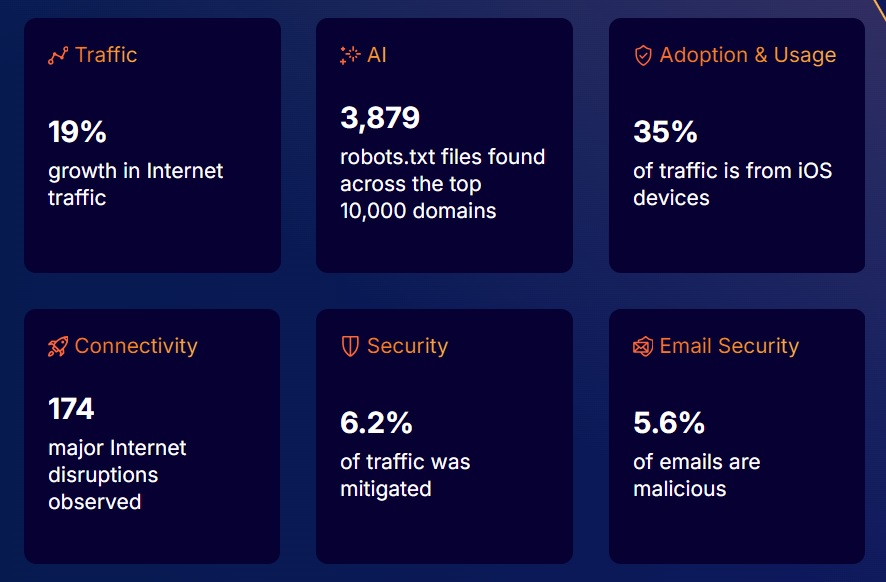
One of the most notable cybersecurity milestones of the year was the expansion of post-quantum encryption, now protecting 52% of all human Internet traffic. This advancement helps safeguard users against future quantum-enabled cyber threats. However, this progress coincided with escalating risks: cyber warfare intensified, resulting in more than 25 record-breaking distributed denial-of-service (DDoS) attacks, redefining the scale and complexity of modern cyberattacks.
“The Internet isn’t just evolving—it’s being fundamentally re-engineered. From the rapid acceleration of AI technologies to increasingly sophisticated threat actors, the digital landscape changes daily. While 2025 delivered major Internet security milestones, it also challenged traditional online business models and pushed the limits of what cyberattacks can look like at scale. With a significant portion of global Internet traffic flowing through Cloudflare’s network, we take seriously our responsibility to help build a safer, faster, and more resilient Internet,” said Matthew Prince, CEO and co-founder of Cloudflare.

Key Internet and Cybersecurity Highlights from Cloudflare’s 2025 Report
Cloudflare’s Year in Review delivers data-driven insights designed to help organizations, governments, and individuals better understand and navigate the evolving Internet ecosystem. Major findings include:
- Google and Meta Remain the World’s Most Popular Internet Platforms
Google and Meta (formerly Facebook) maintained their dominance as the top two global Internet services for the fourth consecutive year. Meanwhile, ChatGPT continued to lead the Generative AI category, reflecting sustained growth in AI-powered tools.
- AI Bot Traffic Surges, Led by Google
Automated AI traffic expanded rapidly in 2025, with Google’s web-crawling bot accounting for more automated Internet activity than all other major AI bots combined, signaling an intensifying race for AI data indexing and training.
- Civil Society Organizations Become Prime Cyberattack Targets
For the first time, non-profit and civil society organizations emerged as the most targeted sector, likely due to the sensitive nature of their data and perceived security vulnerabilities.
- Government Actions Drive Nearly Half of Major Internet Outages

Government-initiated actions were responsible for almost 50% of major global Internet disruptions. While outages caused by undersea cable damage declined by nearly half, power-related outages doubled, highlighting infrastructure fragility.
- Europe Sets the Global Standard for Internet Speed and Quality
European nations led worldwide connectivity rankings, with average download speeds exceeding 200 Mbps. Spain ranked first globally for overall Internet quality, reflecting continued investment in broadband infrastructure.

Data Powered by Cloudflare Radar
All insights in the 2025 Internet Year in Review are derived from Cloudflare Radar, a free analytics platform providing real-time visibility into Internet traffic, security threats, and performance trends. Radar leverages aggregated and anonymized data from Cloudflare’s expansive global network—spanning 330+ cities across 120+ countries—as well as data from Cloudflare’s 1.1.1.1 public DNS resolver, widely used for secure and private Internet browsing.
Together, these insights offer a clear picture of how the Internet is evolving—and what businesses, governments, and users must do to stay secure and competitive in an increasingly connected world.
