

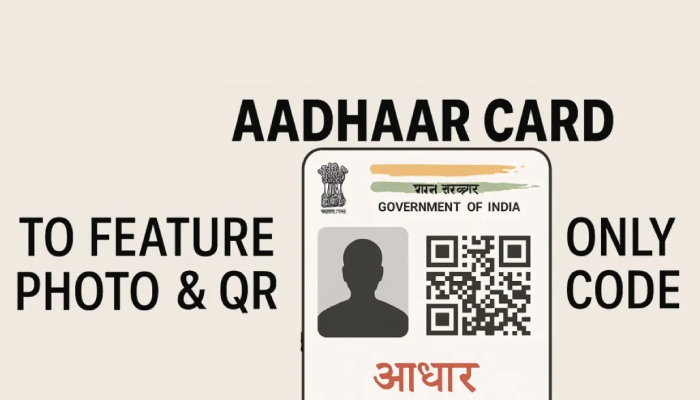
The Unique Identification Authority of India (UIDAI) is reportedly working on a major redesign of the Aadhaar card, aiming to strengthen privacy and reduce the misuse of personal data. According to a PTI report, UIDAI may soon introduce a new Aadhaar format featuring only the cardholder’s photograph and an encrypted QR code, eliminating printed details such as name, address, and Aadhaar number. The move reflects India’s push toward privacy-first digital identity verification.
UIDAI CEO Bhuvnesh Kumar, speaking at an online conference about the upcoming Aadhaar app, said the redesign is meant to discourage outdated and unsafe offline verification practices. Despite being prohibited under the Aadhaar Act, many hotels, event organizers, and private institutions continue to collect photocopies of Aadhaar cards — raising the risk of data theft, identity fraud, and Aadhaar misuse. Kumar emphasized that removing printed details will significantly reduce the misuse of photocopied Aadhaar cards.
The proposed Aadhaar redesign supports faster age verification, KYC checks, and secure identity authentication. The encrypted QR code will store all essential information, allowing authorised entities to verify users safely without exposing sensitive personal details. UIDAI is expected to review the proposal on December 1.
Alongside the physical redesign, UIDAI is preparing to launch a new Aadhaar mobile app, which will replace the current mAadhaar app. The upgraded platform will allow users to update address documents, add family members without mobile phones, update mobile numbers via facial authentication, and perform Aadhaar-based verification at hotels, cinemas, colleges, and events. The new digital identity ecosystem is expected to be more secure, user-friendly, and aligned with the Digital Personal Data Protection Act (DPDPA).
UIDAI recently held discussions with banks, hotels, and fintech companies to explain the upcoming changes and ensure industry readiness. The authority says the redesigned Aadhaar will enable privacy-preserving offline verification, with QR code scanning paired with face matching to confirm identity and physical presence. Offline Verification Seeking Entities (OVSEs) will be required to integrate with the new system, which UIDAI aims to fully implement by December 2025.
The Aadhaar revamp represents a major step toward privacy-first digital governance, reducing personal data exposure while supporting secure, fast, and reliable identity verification across India’s expanding digital economy.
