

In a significant move to strengthen its position in India’s semiconductor ecosystem, the Uttar Pradesh Cabinet has approved a comprehensive incentives package for semiconductor companies investing INR 3,000 crore or more in the state. The decision aligns with the state government’s broader objective of positioning Uttar Pradesh as a major semiconductor and electronics manufacturing hub in India.
The decision was taken during a cabinet meeting chaired by Chief Minister Yogi Adityanath. Addressing the media after the meeting, Finance Minister Suresh Kumar Khanna said that 13 out of 14 proposals placed before the Council of Ministers were approved, underscoring the government’s strong push to attract large-scale investments in high-technology sectors.
Under the approved framework, eligible semiconductor investors will receive customized incentives on a case-to-case basis, including interest subsidies, plant and machinery cost reimbursement, exemption from net State Goods and Services Tax (SGST) for 10 years, and 100% Employees’ Provident Fund (EPF) reimbursement—up to INR 2,000 per month—for professionals who are native residents of Uttar Pradesh. Additional benefits include subsidies on water charges and electricity tariff reimbursement of up to INR 2 per unit for a period of 10 years.
“The objective of these incentives is to attract large-scale semiconductor investments and build a strong manufacturing ecosystem in the state,” Khanna said. He also highlighted the global competitive landscape, noting that countries such as the United States, Europe, Japan, and Taiwan currently dominate semiconductor manufacturing, with Taiwan leading in advanced chip fabrication.
These incentives form part of the Uttar Pradesh Semiconductor Policy, which was launched in January 2024 to accelerate investments in chip manufacturing, electronics manufacturing services (EMS), and allied supply chains. Through this policy, Uttar Pradesh aims to leverage its strategic location, infrastructure readiness, and skilled workforce to emerge as a key destination for semiconductor investments.
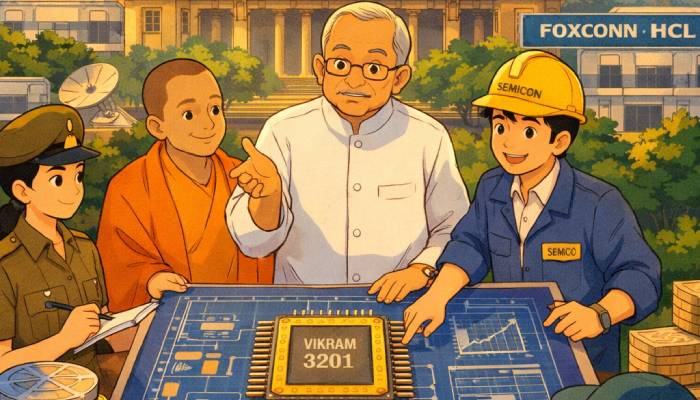
The state already hosts major electronics and manufacturing players such as Dixon Technologies, Samsung, and OPPO. In a major boost earlier this year, the Union Cabinet approved a joint venture between HCL and Foxconn to establish a semiconductor manufacturing unit in Noida under the India Semiconductor Mission (ISM). The JV is expected to invest INR 3,700 crore, further strengthening the region’s semiconductor ecosystem.
Additionally, the Union Ministry of Electronics and Information Technology (MeitY) has approved an INR 417 crore Electronics Manufacturing Cluster (EMC) in Gautam Buddha Nagar, near the upcoming Noida International Airport. The cluster is projected to attract INR 2,500 crore in investments and generate over 15,000 jobs, reinforcing Uttar Pradesh’s role in electronics and semiconductor manufacturing.
In 2024, the UP government secured investment commitments worth INR 40,038 crore under its semiconductor policy, reflecting growing investor confidence. The state’s proximity to Delhi-NCR, extensive expressway network, availability of large land parcels through industrial corridors, and improving ease-of-doing-business environment continue to be key advantages for investors.
At the national level, the Central government is considering a USD 20 billion incentive package for India Semiconductor Mission (ISM) 2.0, aimed at developing an advanced and self-reliant chip manufacturing ecosystem. India also marked a major milestone in 2025 with the development of Vikram 3201, the country’s first indigenous semiconductor chip to progress from design to fabrication readiness.
