

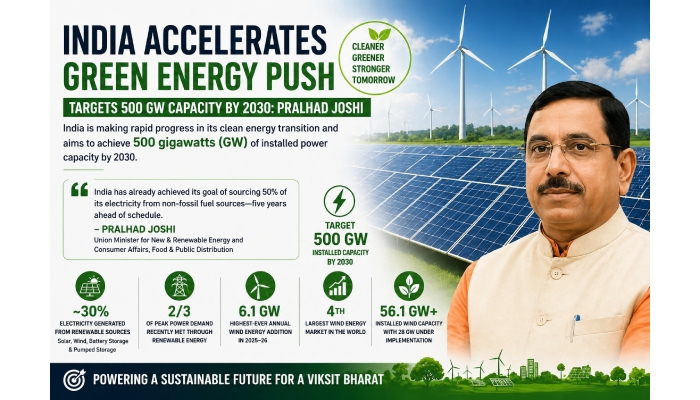
India is accelerating its transition to clean and renewable energy, with a goal of achieving 500 gigawatts (GW) of installed power capacity by 2030, according to Pralhad Joshi. The announcement highlights the country’s growing leadership in renewable energy, solar power, and sustainable infrastructure development.
Speaking at the Resilient Futures Summit 2026 in New Delhi, the Union Minister emphasized that India has already made significant progress under the leadership of Narendra Modi. Notably, the country has achieved 50% of its electricity capacity from non-fossil fuel sources five years ahead of its target, demonstrating strong momentum in clean energy adoption.
Currently, nearly 30% of India’s electricity generation comes from renewable energy sources, including solar, wind, battery storage, and pumped hydro storage. During peak demand periods, renewable energy has met almost two-thirds of the country’s electricity needs, reflecting improved grid efficiency and increased generation capacity.
India’s renewable energy expansion is being driven by large-scale investments in solar power projects, wind energy capacity, and green energy infrastructure. The government is also focusing on a utility-led development model to accelerate project execution and meet upcoming milestones by 2027.
Highlighting recent achievements, Joshi noted that India recorded its highest-ever annual wind energy addition of 6.1 GW in 2025–26, further strengthening its position as the fourth-largest wind energy producer globally. The country currently has over 56.1 GW of installed wind capacity, with an additional 28 GW under development.
With continued investments and policy support, India is positioning itself as a global leader in the renewable energy transition, green hydrogen, and sustainable power generation, aligning with its long-term climate goals and commitment to a low-carbon future.
