

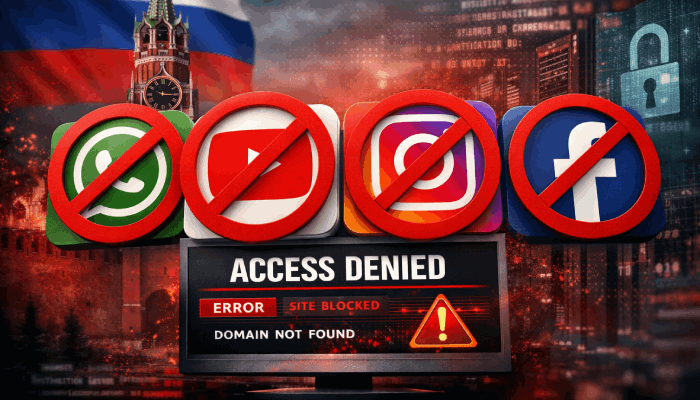
Russia has significantly tightened its internet controls by fully blocking major global digital platforms, including WhatsApp, YouTube, Instagram, and Facebook. The move effectively disconnects millions of users from widely used social media, messaging, and video-sharing services.
According to multiple reports, the domains of these platforms have been removed from the country’s national Domain Name System (DNS), making them technically unreachable across Russia. Users attempting access are now seeing errors indicating that the domains cannot be resolved, as the system no longer translates them into valid IP addresses.
Technology analysts describe this as one of Moscow’s most stringent digital restrictions to date, surpassing earlier measures that relied primarily on traffic throttling or partial access limitations.
International Media Websites Also Blocked
The restrictions extend beyond social media. Prominent international news outlets — including BBC, Deutsche Welle, and Radio Free Europe/Radio Liberty — have reportedly become inaccessible within Russia.
In addition, the Tor Browser, widely used for anonymous internet access and bypassing censorship, has also been blocked.
Digital rights organisations warn that these actions severely restrict access to independent journalism, global news coverage, and alternative viewpoints, further isolating Russia’s online information environment.
Enforced Through Russia’s ‘Sovereign Internet’ Framework
The crackdown is being implemented under Russia’s “sovereign internet” legislation, which requires internet service providers to operate through a state-controlled DNS system overseen by Roskomnadzor.
This regulatory framework enables authorities to centrally manage and filter internet traffic, reducing reliance on foreign digital infrastructure. Since 2021, Russia has progressively limited alternative DNS services such as Google DNS. The current DNS-level removals represent a deeper escalation, making conventional workarounds far more difficult for users.
By targeting platforms at the DNS layer, authorities have effectively implemented near-total shutdowns, rather than simple content restrictions or bandwidth throttling.
Foreign Platforms Face Near-Total Shutdown
Industry observers say the decision will significantly diminish the operational presence of international technology companies and global media organisations within Russia. State-backed platforms and domestic social networks are expected to gain greater prominence as alternatives.
Human rights advocates argue that DNS-level blocking is far more restrictive than traditional website bans because it eliminates standard technical routes for accessing blocked services.
With WhatsApp, YouTube, Instagram, and Facebook now inaccessible nationwide, millions of Russians have lost access to essential communication tools, social networks, and digital business channels. Analysts suggest the move reflects a broader strategy to consolidate state control over the digital ecosystem.
The development signals an accelerating shift toward a closed, state-managed internet infrastructure in Russia — a transformation that could permanently reshape online communication, information access, and digital commerce within the country.
