

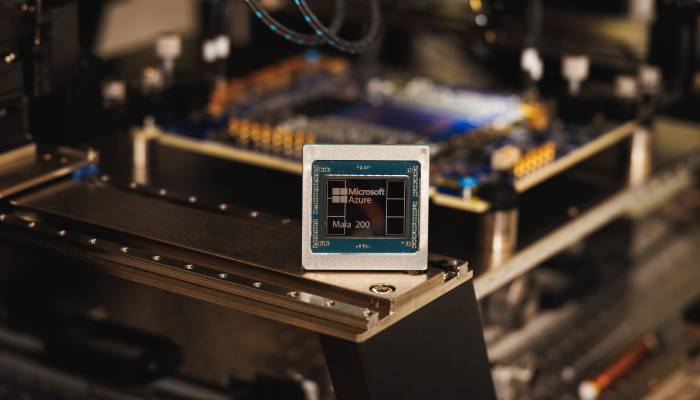
Microsoft has rolled out the second generation of its in-house artificial intelligence chip, Maia 200, marking a major step in its strategy to reduce reliance on Nvidia and strengthen its position in the rapidly evolving AI chip and cloud computing market. Alongside the hardware launch, Microsoft also introduced new AI software tools aimed at closing Nvidia’s long-standing advantage with developers.
The Maia 200 AI accelerator is now live in a Microsoft data center in Iowa, with a second deployment planned in Arizona. This latest release builds on Microsoft’s first Maia chip, introduced in 2023, and reflects the broader industry trend of hyperscalers developing custom AI silicon to power generative AI, large language models (LLMs), and enterprise AI workloads.
Microsoft joins rivals Google, Amazon Web Services (AWS), and Meta in challenging Nvidia’s dominance. Google, in particular, has attracted interest from major Nvidia customers such as Meta Platforms, as it works to close critical software performance gaps between its AI chips and Nvidia’s ecosystem.
A key part of Microsoft’s strategy is software. Along with Maia 200, the company is offering a new developer toolchain, including Triton, an open-source programming framework with major contributions from OpenAI. Triton is positioned as an alternative to CUDA, Nvidia’s proprietary software platform widely considered its strongest competitive moat in the AI hardware market.
Manufactured by TSMC using advanced 3-nanometer process technology, Maia 200 features high-bandwidth memory (HBM) and a large allocation of SRAM, enabling faster response times for AI inference tasks such as chatbots and real-time AI applications. While it uses an older generation of HBM compared to Nvidia’s upcoming chips, the SRAM-heavy design offers efficiency advantages for handling high user request volumes.
With Maia 200, Microsoft is accelerating its push toward vertically integrated AI infrastructure, combining custom silicon, open-source software, and cloud services to better support generative AI workloads and compete directly with Nvidia in the next phase of AI computing.
