


A new global survey from Riverbed reveals that manufacturing organizations are rapidly increasing investments in artificial intelligence, yet many remain unprepared to deploy AI across their operations at scale. The report, “The Future of IT Operations in the AI Era,” highlights strong optimism around AI but also underscores persistent challenges around data quality, infrastructure readiness, and operational integration.
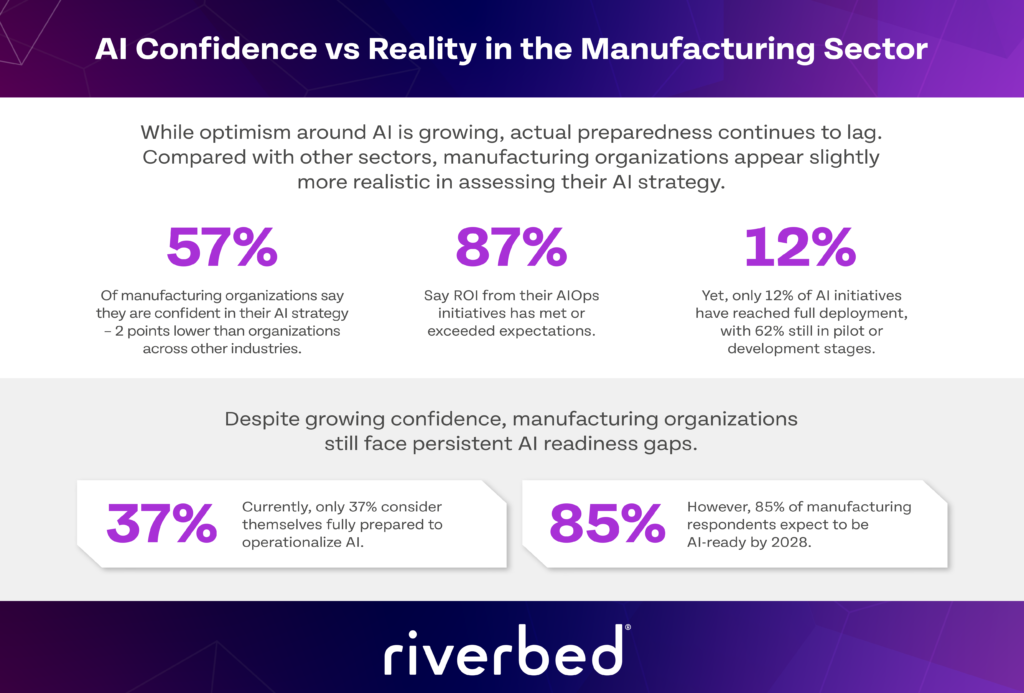
According to the study, 87% of manufacturing leaders say their returns from AIOps initiatives have met or exceeded expectations. Despite this positive outlook, only 37% report being fully prepared to operationalize AI across their enterprises. A majority of initiatives are still in early phases, with 62% of AI projects currently in pilot programs or development stages.
Data quality continues to be one of the biggest barriers to AI success in the sector. While 90% of respondents agree that improving data quality is critical for successful AI outcomes, nearly half of organizations (47%) lack confidence in the accuracy and completeness of their data. Only 34% rate their data as highly relevant and suitable for AI-driven initiatives. These findings highlight a clear gap between leadership optimism about AI and the technical readiness required for real-world implementation.
Manufacturing companies are also focusing heavily on simplifying their IT ecosystems. On average, organizations currently rely on 13 observability tools from nine different vendors, creating operational complexity. As a result, 95% of manufacturers are prioritizing tool consolidation to reduce costs, streamline workflows, and improve operational efficiency. When evaluating new tools, organizations are primarily looking for stronger integration capabilities, reduced vendor management overhead, and improved IT productivity.
Unified communication platforms are increasingly used across manufacturing environments, particularly as remote collaboration becomes more common. However, performance issues remain widespread. While 66% of respondents consider unified communication tools essential for weekly operations, only 45% report being satisfied with their performance, with many citing limited visibility, dropped calls, and integration challenges.
The survey also shows growing adoption of OpenTelemetry, with 44% of organizations fully implementing it and another 42% currently adopting the framework. Nearly all respondents believe cross-domain observability enabled by OpenTelemetry will play a crucial role in supporting AI-driven automation and future IT strategies.
Finally, data movement and network performance are emerging as critical foundations for AI. Over 90% of respondents say efficient data sharing is important to their AI strategy, and three-quarters plan to establish dedicated AI data repositories by 2028. As manufacturers push toward AI-powered operations, improving data infrastructure, network performance, and security will be essential to turning AI investments into scalable business outcomes.
