

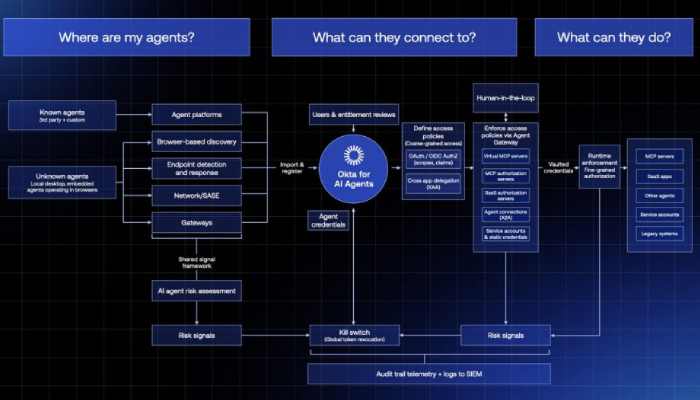
Okta has introduced a new secure agentic enterprise blueprint, aimed at helping organizations navigate the rapidly evolving landscape of AI security, agentic AI, and enterprise identity management. Alongside this framework, the company announced Okta for AI Agents, a comprehensive platform designed to manage, secure, and govern AI agents at scale. The solution is set to become generally available on April 30, 2026.
As enterprises increasingly adopt AI agents, autonomous systems, and generative AI applications, traditional security models are proving inadequate. Okta’s new framework addresses three critical questions for organizations operating in the agentic AI era: where AI agents exist, what systems they can access, and what actions they are authorized to perform. This structured approach enables businesses to maintain visibility, enforce control, and mitigate risks associated with autonomous AI operations.
The Okta for AI Agents platform provides capabilities to discover, register, and manage both known and unknown AI agents, including “shadow AI” created outside IT governance. By treating AI agents as first-class digital identities, the platform allows enterprises to apply identity-based security controls, assign ownership, and track agent behavior across systems. This is particularly important as AI agents become more autonomous and capable of executing complex workflows.
To enhance visibility and governance, Okta is expanding its integration ecosystem to include leading AI platforms, enabling seamless onboarding and centralized management of AI agents. The platform also strengthens enterprise security through features such as agent discovery, identity lifecycle management, and real-time monitoring, helping organizations detect potential vulnerabilities and unauthorized access.
A core component of the solution is the Agent Gateway, which acts as a centralized control layer for managing how AI agents interact with enterprise applications, APIs, and data systems. Combined with API access management and privileged credential security, this ensures that AI agents operate under strict least-privilege access policies, reducing the risk of data breaches and lateral movement within enterprise environments.
One of the most critical features introduced is the “kill switch” capability, which allows organizations to instantly revoke access for any AI agent exhibiting suspicious or unauthorized behavior. This universal logout functionality provides a powerful safeguard against compromised or rogue agents, enabling rapid response to emerging security threats.
The platform also includes advanced logging and audit capabilities, allowing enterprises to track every action performed by AI agents, including tool usage, access attempts, and authorization decisions. These logs can be integrated with existing security systems, providing deeper insights into AI-driven operations and risk management.
With the rise of sophisticated AI agents capable of autonomous decision-making and multi-step task execution, the need for enterprise-grade AI governance, identity security, and compliance frameworks has never been greater. Okta’s blueprint positions itself as a foundational approach to securing the next generation of AI-powered enterprise environments.
By launching Okta for AI Agents, the company is setting a new standard for AI identity security, zero trust architecture, and agent governance, helping organizations confidently scale their AI initiatives while maintaining full control over security, access, and compliance.
